
Mid-drive vs hub-drive ebike motors: which one should you buy?
Independent ebike guidance. No brand pays to change the verdict. Some links are affiliate links. Read our disclosures.
Nearly every ebike runs one of two motor types: hub-drive or mid-drive.
The choice changes how the bike rides, what it costs to maintain, and whether it suits the way you ride.
Most buyers pick one without knowing what they are choosing.
Short answer: a hub-drive is a solid, low-maintenance choice for flat or gently rolling terrain.
A mid-drive is worth the extra money if you ride hills or want the best performance, but drivetrain maintenance comes with it.
Watch the video version on YouTube
Hub-drive vs mid-drive at a glance
| Hub-drive | Mid-drive | |
|---|---|---|
| Motor location | In the wheel hub, usually the rear | In the middle of the frame, between the pedals |
| Works with the gears? | No, independent of the chain and gears | Yes, power goes through the chain |
| Hills | Fine on gentle slopes, struggles on steep ones | Much stronger, especially in a low gear |
| Drivetrain wear | Low | Higher, chains and cassettes wear faster |
| Weight balance | Heavier at the back | Low and central |
| Repair and servicing | Cheaper, widely serviceable | Pricier, often brand-specific tools |
| Typical starting price | About $800 to $1,200 | Around $2,000 and up |
| Best for | Flat city riding, simplicity | Hills, longer or mixed-terrain rides |
Independent explainers agree on the trade-off. A mid-drive can use the bike's gears, which makes it more efficient on hills. Its torque also passes through the chain and cassette, so those parts wear faster (BikeTips).
How a hub-drive works
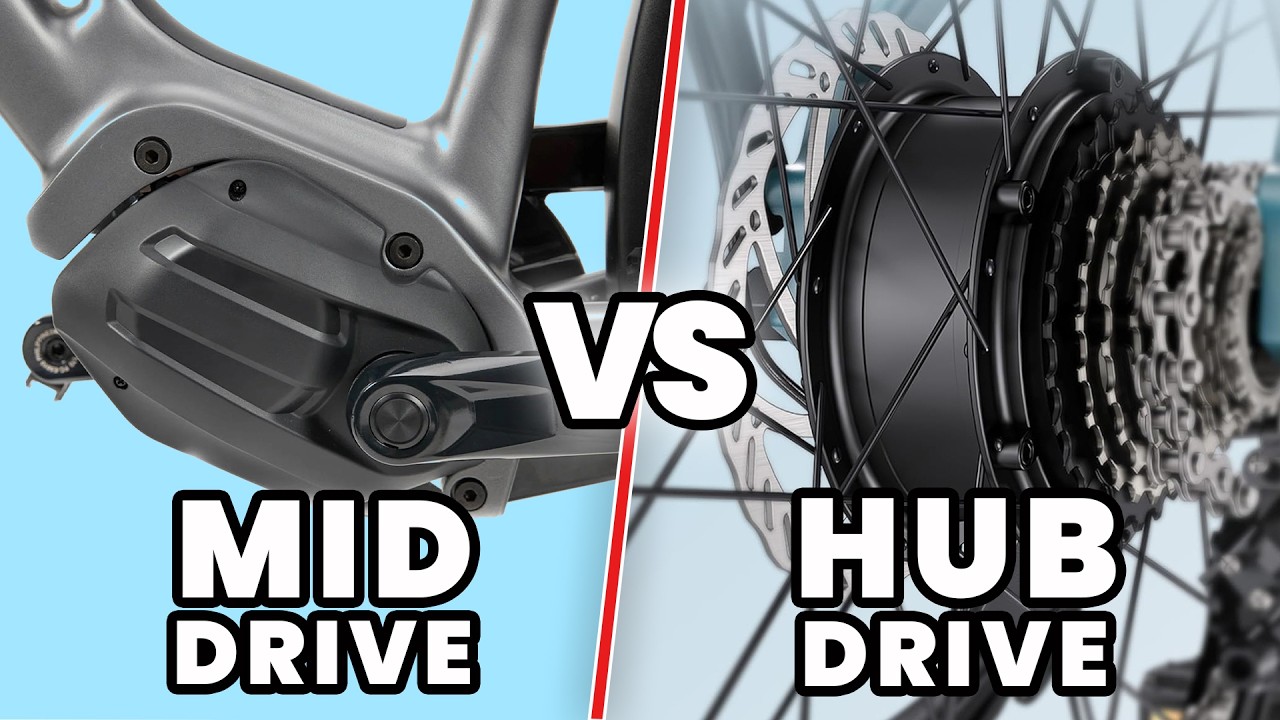
The motor sits inside the wheel hub, most often the rear wheel, and drives the wheel directly.
It is independent of the chain and gears.
You could lift the rear wheel, hit the throttle and the wheel would spin with the chain sitting still.
You could even take the chain off.
In practice, that means the gear you are in makes no difference to how the motor performs.
Think of a car with no gearbox, stuck in one fixed ratio.
It pulls away fine and cruises on the flat, but it struggles uphill and never reaches a proper top speed on a long straight.
How a mid-drive works
The motor sits in the middle of the frame, between the crank arms, and delivers power through the chain, the same way your legs do.
That means the gears affect the motor.
A lower gear gives more torque, and a higher gear allows a higher top speed.
It is like a car with a proper gearbox: first gear for torque when starting or climbing, higher gears for speed on the flat.
Which performs better?
Compared at the same power, mid-drive motors consistently outperform hub-drive motors, and hills are where the gap is clearest.
A mid-drive in a low gear climbs with considerably more torque than a hub-drive of the same wattage.
There is a longevity angle too.
Used with sensible gear choice, a mid-drive runs at an efficient RPM and puts less strain on the motor.
A hub-drive cannot change gears, so on steep inclines it can work harder than necessary, which can shorten its life over time.
The hidden cost of a mid-drive
All of a mid-drive's power runs through your chain, cassette and chainring.
If you put the motor under heavy load in a gear that is too high, you stress those parts.
Mid-drive owners typically go through chains and cassettes noticeably faster than hub-drive owners.
On a hard-ridden mid-drive, a chain can wear out in 1,000 to 2,000 km in some cases, compared with around 3,000 km or more on a conventional bike.
Not every rider will see this, and quality components help, but it is a real running cost that rarely gets mentioned.
The fix: Learn to shift properly before you start grinding up steep gradients in a high gear.
A hub-drive avoids all of this because the motor is separate from the drivetrain.
Mechanically it is simpler, with less to wear out.
Weight and handling
Hub-drive weight sits at the wheel, which pushes weight to the back.
The bike can feel rear-heavy, especially when you lift it, carry it upstairs or load it on a rack.
A mid-drive sits low and central, close to the bike's natural center of gravity.
It feels more balanced, particularly at low speeds and in tight spaces. On flat city streets this matters little.
On longer rides, mixed terrain or off-road, it matters a lot.
Cost and repair
Hub-drive motors are cheaper to build and to repair.
The motor is a self-contained unit, so you can often swap the whole wheel without touching the rest of the bike.
Parts are widely available and most bike shops can work on them.
Mid-drive systems cost more. Bosch, Shimano and Yamaha are the dominant makers, and their motors are well engineered and reliable.
Servicing usually needs brand-specific tools and knowledge, so depending on where you live, finding a shop that can service a Bosch system may take some research.
As a rough benchmark, entry-level hub-drive ebikes start around $800 to $1,200.
Decent mid-drive bikes start around $2,000 and go up from there.
Which should you buy?
Choose a hub-drive if you are new to ebikes, ride mostly flat or gently rolling terrain, and want something simple that does not need gear management. Day to day it is easier to live with and cheaper to maintain.
Choose a mid-drive if you regularly face hills, want the best performance from the motor, or plan longer and more demanding rides. Go in knowing that drivetrain maintenance is part of the deal.
Be honest about where you will actually ride.
A hub-drive on flat city streets will comfortably outperform a mid-drive that is sitting in the wrong gear.
If range matters too, see our 7 ebikes with the longest range. Mid-drives are more energy efficient, especially on hills.
Frequently asked questions
Is a mid-drive better than a hub-drive?
At equal power, a mid-drive performs better, especially on hills, because it works with the bike's gears. It also costs more and wears the chain and cassette faster. A hub-drive is simpler and cheaper to maintain.
Which ebike motor is better for hills?
A mid-drive. In a low gear it delivers considerably more torque than a hub-drive of the same wattage.
Do mid-drive ebikes cost more to maintain?
Usually yes. Chains and cassettes can wear much faster, and servicing often needs brand-specific tools. Hub-drives are simpler and cheaper to repair.
How much does each type of ebike cost?
Entry-level hub-drive ebikes start around $800 to $1,200. Decent mid-drive ebikes typically start around $2,000.
Is a hub-drive fine for a beginner?
Yes. If you ride flat or gently rolling terrain and want a simple bike without gear management, a hub-drive is a completely solid choice.
Disclosure
Independent ebike guidance. No brand pays to change the verdict.
Specs and prices are as of the video publish date and may change. Always confirm with the brand before buying.